
The real reason why Giannis Antetokounmpo didn't sign with the Boston Celtics
We dissect the reasons why the Celtics management decided to give up on improving their offer to sign Antetokounmpo.
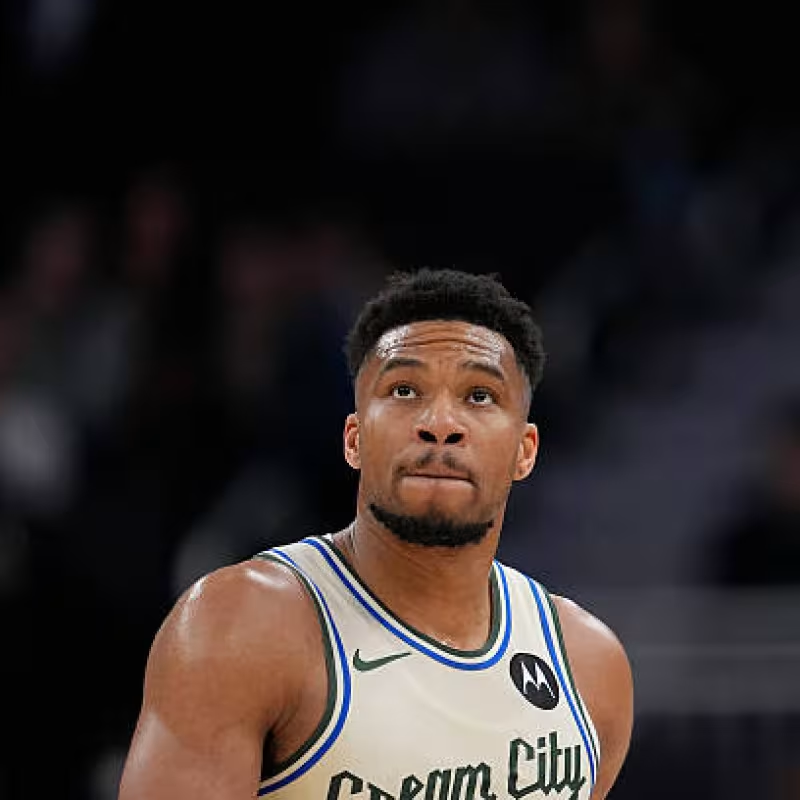
Boston Celtics came close to securing Giannis Antetokounmpo, but negotiations with Milwaukee Bucks ultimately fell through due to the additional demands from the Wisconsin franchise. The Bucks wanted more young and active draft picks in addition to Jaylen Brown, a request that the Celtics deemed excessive.
The revelation came from Shams Charania, who explained that the Celtics had very serious discussions with the Bucks during this pre-draft cycle. The issue was not with Jaylen Brown or the draft rounds offered by Boston. The disagreement arose when Milwaukee asked for more, and the Celtics decided they had reached their limit.
Boston put Jaylen Brown on the table
One of the most notable aspects of this whole story is that the Celtics were actually willing to part ways with one of the cornerstones of their project.
As Charania explained, the offer presented to Milwaukee included Jaylen Brown and up to two unprotected first-round picks. It was a very significant package, especially considering Brown's level of performance in recent seasons.
The forward was not only the Finals MVP in 2024 but also coming off an extraordinary campaign in which he reaffirmed himself as one of the best players in the NBA.
Therefore, Boston's initial proposal seemed sufficient to compete with almost any offer on the market.
However, for Milwaukee, it was not.
The Bucks wanted much more than Brown
Milwaukee's stance was very clear from the start.
The organization understood they were negotiating the departure of the best player in the franchise's modern history and wanted a return capable of accelerating a complete rebuild.
For that reason, the Bucks demanded the inclusion of several young assets that Boston considered strategic for their future.
Among the names mentioned by Charania were Hugo González and Baylor Scheierman, in addition to other potential young pieces from the squad. Milwaukee also aimed to acquire more future picks and swap rights.
In other words, the Bucks were seeking an operation that would not only allow them to receive a star like Brown but also rebuild a large part of their future through young talents and draft assets.
And that's where the negotiations began to cool off.
Hugo González had more significance than it seemed
One of the most interesting details of this whole story is the weight that Hugo González had in the discussions.
During the initial rumors about Giannis, most fans focused on Brown, the draft picks, or even potential third parties involved. However, Milwaukee quickly identified the Spaniard as one of the players they wanted to bring in.
It's not surprising.
Hugo has left very good impressions since arriving in Boston. His defensive ability, competitive intensity, and room for growth have made him one of the most valued young players within the organization.
That's precisely why the Celtics resisted including him.
The franchise believes that the Spaniard can play an important role in the coming years, especially on a roster that will need to progressively rejuvenate around Jayson Tatum.
And that assessment turned out to be decisive.
Boston decided to protect its future
The key issue was that the Celtics didn't want to repeat mistakes that other franchises have made in the past.
Acquiring Giannis represented an extraordinary opportunity but also meant emptying a good portion of the assets still held by the organization.
From Boston's perspective, there was a red line.
Trading Brown was a painful decision but acceptable if it allowed them to bring in one of the top three players on the planet. However, adding several promising young players, multiple additional picks, and swap rights meant mortgaging practically the entire future of the franchise.
And the Celtics' leadership deemed the price too high.
That's why the negotiations ended up falling through.
The Kevin Durant precedent haunting Brown again
The situation also leaves an uncomfortable consequence within the organization.
As Charania recalled, this is the second time in four years that Boston has used Jaylen Brown as the main piece of a negotiation to acquire a superstar.
The first time was in 2022 when the Celtics explored a trade for Kevin Durant.
Now, something very similar has happened with Giannis.
The difference is that Brown's status has changed radically since then.
He is no longer just an All-Star. He is a Finals MVP, a player who has shown he can lead a champion, and one of the most respected figures in the entire league.
That's why it's inevitable to wonder how this situation will affect his relationship with the franchise.
Will there be consequences for the Celtics?
That is the big question raised by this episode.
Brown will be eligible for a new contract extension in July and now must manage a reality that is hard to ignore: the Celtics were willing to include him in a trade for the second time in his career.
It doesn't necessarily mean he wants to leave Boston.
Nor does it imply that the relationship between both parties is broken.
But it does open a discussion that will likely accompany the franchise for much of the summer.
Especially because Boston is going through a delicate moment after Jayson Tatum's injury and needs to define what its project will look like in the coming years.
Giannis didn't arrive, but the story is not over yet
The most obvious conclusion is that Antetokounmpo's signing did not fail due to lack of ambition.
Boston made a significant offer.
Milwaukee asked for more.
And the Celtics decided the cost was too high.
The deal fell through, but the consequences remain. The Bucks will start a new era without Giannis, Miami Heat emerges as the top favorite to land the Greek, and Boston will now have to manage the aftermath of once again putting Jaylen Brown on the market.
Because even if Antetokounmpo never wears green, the trade negotiations surrounding him could deeply influence the Celtics' immediate future.
This is an automatic translation. You can read the original news, La verdadera razón por la que Giannis Antetokounmpo no fichó por Boston Celtics