
Mitch Johnson and the decision that could cost the Spurs a ring
The San Antonio Spurs coach is not giving the deserved confidence to a much more productive Dylan Harper than De'Aaron Fox.
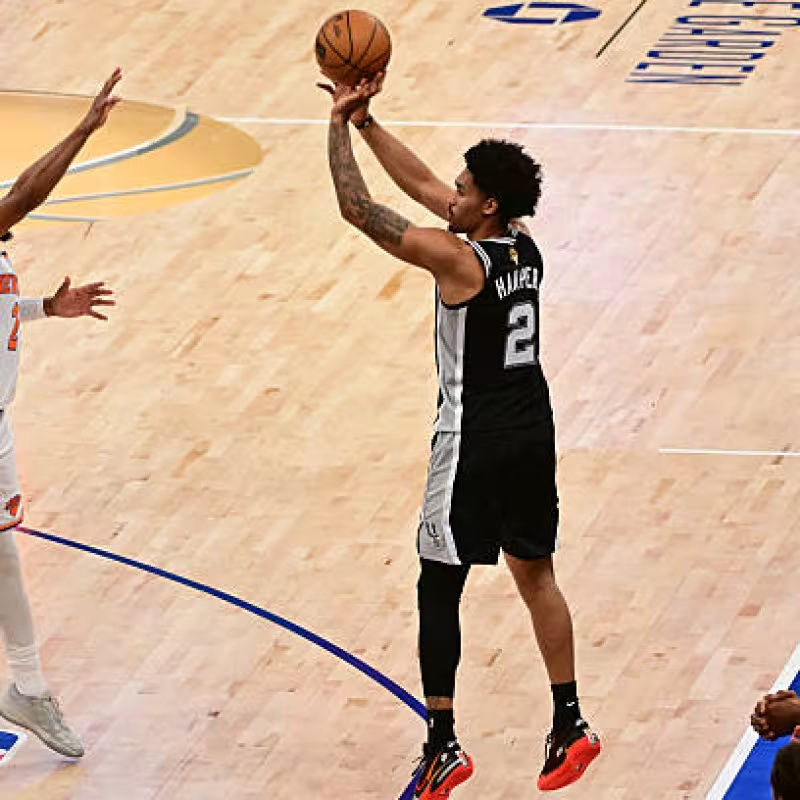
San Antonio Spurs are on the brink after squandering a 29-point lead in the fourth game of the 2026 NBA Finals. The New York Knicks' comeback has put the series at 3-1, triggering a wave of criticism towards a franchise that seemed to have full control of the game for most of it. Despite player execution errors, more voices are pointing directly at Mitch Johnson.
The Spurs' coach has done an outstanding job for much of the season, but the Finals are raising an increasingly uncomfortable question: is he managing the distribution of responsibilities between De'Aaron Fox and Dylan Harper correctly? For many fans and analysts, the answer is becoming clear in the negative.
The debate has been growing since the first game
The controversy didn't start in Game 4.
Throughout the series, there has been an increasingly evident feeling that Dylan Harper has been the better playmaker for San Antonio. The rookie has not only shown extraordinary maturity for his age but has also provided the team with offensive fluidity that often disappears when the ball is in Fox's hands.
Advanced statistics and the Spurs' performance with both players on the court have further fueled that debate. In numerous Finals stretches, San Antonio has functioned better with Harper leading the offensive creation than with the veteran guard taking on the main role.
Nevertheless, Johnson has continued to rely on Fox in critical moments.
A decision that to some extent could be understood in the early games due to the ex-Sacramento Kings player's experience, but has become much harder to justify after what happened in the fourth game.
The last quarter that could haunt Johnson for years
When the Knicks started their comeback, many expected the Spurs' coach to definitively hand over the team's reins to Harper.
The young guard had once again shown personality, rhythm control, and a remarkable ability to find offensive advantages. However, Johnson took the opposite path.
Fox continued to monopolize much of the offensive decisions during the most delicate moments of the game.
And that's where the big problem arises.
The experience justifying that choice has barely been reflected on the court during these Finals. Fox has failed to steady the team in tense moments, failed to control the pace when the Knicks began to narrow the gap, and has not managed to generate the expected offensive impact for a player of his status.
Meanwhile, Harper watched from a secondary role as the game slowly slipped away from San Antonio's hands.
Dylan Harper is playing like a star
Most striking about this situation is that the debate is not about a future promise.
Harper is already producing at a star level.
His performances during the playoffs and especially in the Finals have confirmed what many observers have been anticipating for months: San Antonio has found one of the great talents of the next generation.
The rookie plays with an unnatural calmness for his age. He makes good decisions under pressure, knows when to speed up and when to slow down the game, and seems comfortable even in the most demanding scenarios.
That's why some of Johnson's decisions are so hard to understand.
When such a young player shows such level of preparation, there comes a point where experience ceases to be a sufficient argument to maintain certain hierarchies.
And many believe that moment has arrived.
The fear of breaking the hierarchy may be proving too costly
There is a relatively simple explanation to understand the coach's standpoint.
Fox came in to become the main partner of Victor Wembanyama. He's an established star, one of the highest-paid players in the squad, and a player with years of NBA experience.
Radically changing that structure during the Finals is not an easy decision.
The problem is that basketball rarely cares about contracts or resumes when it comes to competing for a championship.
The only thing that matters is who's playing better.
And for much of this series, the feeling is that Harper has been the point guard who has best understood what the Spurs needed.
The insistence on keeping the initial hierarchy intact is starting to raise significant doubts about Johnson's ability to adapt to what unfolds on the court.
A decision that could have consequences beyond these Finals
If San Antonio ends up losing the championship, post-analysis is inevitable.
And one of the first topics to arise will precisely be the management of minutes and responsibilities between Fox and Harper.
Because this no longer seems like an isolated discussion about a specific rotation. It's becoming a structural issue for the franchise's future.
Harper's explosion during these playoffs has sparked a debate that will likely linger with the Spurs throughout the summer. Many already believe that the young guard is ready to take on a much larger role in the project.
If Johnson continues to ignore that reality, the criticisms will keep growing.
The coach also plays the Finals
A widely repeated phrase in the NBA gains special relevance in moments like this: coaches also play in the playoffs.
The Finals do not only assess the stars. They also test the coaches' ability to read situations, adapt, and make tough decisions under pressure.
So far, Mitch Johnson's choice between De'Aaron Fox and Dylan Harper is one of the most discussed topics of the whole series.
And after the collapse in the fourth game, the pressure on the coach is higher than ever.
Because the Spurs can still come back. They can still win three straight games and pull off one of the greatest feats in NBA history.
But to achieve that, Johnson may have to accept a reality that increasingly appears evident: the player who is best leading San Antonio in these Finals is not the veteran he brought in to lead the project, but the rookie knocking on the door of superstardom much sooner than expected.
This is an automatic translation. You can read the original news, Mitch Johnson y la decisión que puede costarle un anillo a los Spurs